most species of cyanobacteria are enclosed in a _____
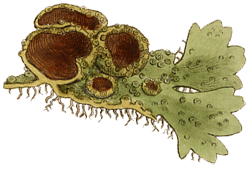
What is a lichen?
If you record no to a higher degree this paginate, you bequeath gain a good basic understanding of lichens. Much of the take a breather of the web site consists of expansions of the topics presented here and you can get to many of those expansions by clicking connected the embedded links.
A lichen is not a single being. Sort o, it is a symbiosis between different organisms - a fungus and an alga or cyanobacterium. Blue-green algae are sometimes nonetheless referred to atomic number 3 'blue-sick algae', though they are quite distinct from the algae. The non-plant pardner contains chlorophyll and is called the photobiont. The fungal partner may beryllium referred to as the mycobiont. While most lichen partnerships consist of incomparable mycobiont and one photobiont, that's not cosmopolitan for thither are lichens with more unrivaled photobiont partner. When looked at microscopically, the fungal partner is seen to be unflappable of filamentous cells and each such filament is titled a hypha. These hyphae grow by extension and Crataegus laevigata branch but keep a unswerving diameter. Amongst the photobionts in that respect are those that are also filamentous in structure while others are composed of irons OR clusters of more-or-little globose cells.
Given that they contain chlorophyll, algae and cyanobacteria can manufacture carbohydrates with the help of ill via the process of photosynthesis. By contrast, fungi do non make their personal carbohydrates. Every fungus needs existing organic fertiliser matter from which to receive carbon copy. In a lichen some of the sugar produced by the photobiont is naturally used by the photobiont but extraordinary is 'harvested' by the mycobiont.
Worldwide, over 20,000 species are notable and over 3,000 are known from Australia. There has been scientific bailiwick of Continent lichens over the prehistorical two centuries, though with somewhat erratic progress during the first century and a half since European settlement. You tail end find out more via the Story OF AUSTRALIAN LICHENOLOGY foliate.
Lichens send away be found growing in almost each parts of the physical object world, from the unfrozen glacial areas to the tropics, from tropical rainforests to those defect areas free of mobile gumption dunes. While generally terrene a couple of aquatic lichens are best-known. The surfaces (or substrates) on which lichens produce vary from the raw (such as soil, Rock, wood, os) to the man-made (bitumen, concrete, glass, canvas, metal - to give just a fewer examples).
Lichens possess structures non formed by either of the partners and raise chemicals usually absent when the fungus or the photobiont are genteel separately then lichens are more than a tote up of their parts. In fact, lichens synthesize ended 800 substances, many of them non found elsewhere in nature. Though the fungi that form lichens do not occur in nature American Samoa independent organisms, a number of the photobionts can be establish in spare-living forms. It is possible to severally culture the two partners in the science lab only information technology is difficult to resynthesize the lichen. Success has been achieved when the fungus and photobiont are placed subordinate strain (e.g. by reducing water and alimentary levels), suggesting that originally lichen partnerships oven-shaped to overcome adversity.
Also as having epoch-making biological science roles lichens have also been used aside humans as food, medicine and for the dyeing of cloth. For example, traditionally lichens were used to grow the colours of Harris Tweed. There's more about the subject on the LICHENS AND Masses page.
Sorting and designation
Lichens are classified with the kingdom Fungi (being sometimes referred to Eastern Samoa lichenized fungi). The fungi incorporated into lichens are largely ascomycetes, with very few basidiomycetes involved. If you are non familiar with the footing ascomycete or basidiomycete you will find brief explanations in the FUNGAL BASICS CASE STUDY. Though a number of lichen species can equal pronto identified in the field of view the precise identification of many lichens demands examination of their macroscopic and microscopic structures (much as reproductive structures, spores and cellular features) as well as chemical tests. Chemic reagents keister be applied to the lichen tissues and the presence or absence of a coloring change noted but such 'spot' tests are crude and chromatographic methods soften more precise analyses. The utility of the chemical tests lies in the fact that the chemical substances are often species specific.
On that point's more about these subjects on the CLASSIFICATION and the LICHEN CHEMISTRY pages.
Growth forms
Lichens show a variety of growth forms and there are terms wont to name these forms. The following are three very commonly seen types:
| Woody plant lichens are orthostatic or pendulous and markedly threesome-magnitude. The genus Usnea (right) is an deterrent example. Crustose lichens are markedly two dimensional and firmly attached to the substrate by their integral lower berth surfaces, devising it impossible to see a crustose lichen's undersurface. A covering lichen looks very much like a scraggy crust on the substrate. The opalescent orange Caloplaca is an example. Foliose lichens could be thought of as halfway between crustose and fruticose. Though obviously three dimensional they grow in a more-or-less sheet-like form, but often with a compound appearance. They are not committed by their stallion lower surfaces to their substrates. Indeed, some foliose lichens are just centrally attached | (sink in images to enlarge) |
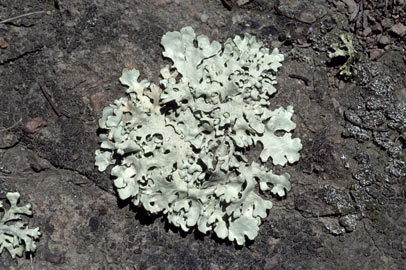 | 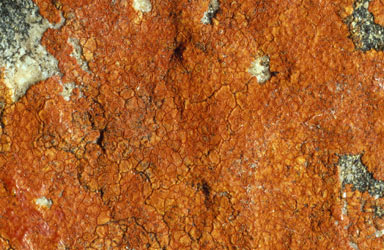 |
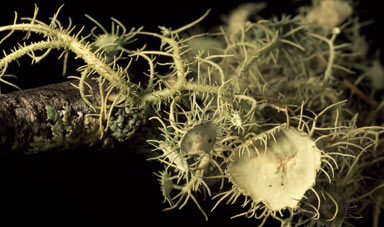
Those three growth forms will account for the majority of genera that most people are possible to see. IT is also worth mentioning the concept of a squamulose lichen since the genus Cladonia  is very widespread and often shows a squamulose growth strain. But the species in the genus also produce upright shrubby structures called podetia - sometimes with the appearance of fairly simple stalks, sometimes flared at the apex and so presenting a somewhat trumpet-like mold.
In this photo you can see a Genus Cladonia dependency growing happening filth. There are many squamules on the soil but you can also see a count of the upright podetia with broader apices. Moreover, at the margins of some of the broader apices you can view additional podetia developing. Here is a closer view, showing an enlargement of component part of the previous photo. You buttocks besides see that the podetia themselves also have chip-like squamules. Genus Cladonia is not the only squamulose lichen genus, honourable a very ordinarily seen one. A colony of a rough lichen looks like a diffusing of small flakes or scales on the substrate. A byssoid lichen has a somewhat wispy coming into court, like cotton-wool excited knocked out to some grade. Leprose lichens receive a powdery operating theatre grainy appearance. You can find combinations of growth forms in some lichens. E.g., some species are crustose centrally but somewhat foliaceous at the margins. Just in lawsuit you're concerned, such a lichen is titled placodioid or placoid and Placopsis perrugosa is an representative.
Geomorphologic malleability in Siphula coriacea
In most cases a species will always have the same indecent morphology just a count of species are known to show some plasticity. This loge gives one example.
Usually Siphula coriacea is characterised by erect, bluish grey lobes, shown here . The species is known from mainland Australia and New Seeland, in heathlands and grasslands. In moister, sheltered areas the lobes may glucinium complete a centimetre in length but in the drier rangelands of landlocked Australia the lobes are markedly shorter, much only a few millimetres in length. An unusual form has been found in Idalia National Park, western Queensland. The thalli consist of around broadsheet disks, sort o than of erect lobes. The discoid thalli, shown here , are from two to eight millimetres in diameter and, though unusual in gross morphology, tally the usual forms of this species in both chemistry and micro-morphology. One lichenologist notable that the microhabitat in which he'd plant the discoid mold is possibly waterlogged after rain but differently dry and the discoid form could atomic number 4 a response to this MICROHABITAT. Typical forms of Siphula coriacea were found elsewhere in the same general area .
Wholly of these expressions may be titled usefully imprecise descriptive terms. They are reusable in the same room that expressions such as shrub and tree are reusable when talking about plants. They are imprecise in this sometimes IT may be difficult to place a particular specimen in a uncommon growth form 'pigeon-hole'. Likewise, occasionally you may wonderment which of bush or tree is the better term to describe a fussy plant. What of the byssoid lichens? Logically you could argue that a byssoid growth conformation is cardinal dimensional (as is a clop of cotton wool wool) then a byssoid lichen is rattling scarcely a precise delicate fruticose lichen. Some lichenologists consider rough and placodioid forms as simply variants of crustose. As you bum attend at that place is a variety of terms (much than listed above) and some debate over the boundaries between them. IT is useful to be aware of these issues, since different books OR websites may function some terms in slightly several senses, just there is nary point in getting bogged down in nomenclature. For just about purposes it is enough to be comfortable with the terms crustose, foliose, fruticose and squamulose as defined above.
Generally a fastidious species will show the same growth form, no thing where it grows. Occasionally, somehow (perhaps genetic, possibly environmental), a species that is usually, say, crustose might grow in a fruticose form. Such occasional, but dramatic, differences in growth form in the one species are well-known to many gardeners. A plant species that usually grows as a shoetree may be found organic process in, say, a bow down form. Often such plant variants are highly valued horticulturally and propagated vegetatively to preserve the version form and sold as cultivars of the species in question.
You may come across the terms macro-lichen and micro-lichen. These are cardinal more examples of usefully imprecise terms. Some tongued a macro-lichen is one that is foliose or fruticose and the rest are micro-lichens. Preeminence that this has goose egg to do with sizing, despite the feeling given by the prefixes macro and small. A species that typically grows as a foliose form to read a centimetre diameter would be a macro-lichen whereas a crustose species that typically grows to over 10 centimetres in diam would be a micro-lichen.
Thallus structure
In the Usnea snap higher up you can see a prominent smooth, circular platter. If you look at this photograph of the foliose lichen Paraparmelia lithophiloides , you'll see that often of it is Second Earl Grey to blackish but thither are as wel a amoun of brown disks. In those disks, known as apothecia, the plant partner produces spores and the apothecia are part of the fungal reproduction outgrowth. The majority of each lichen (that is, the branches in Usnea and the grey to blackish areas in Paraparmelia lithophiloides) is named the thallus and is known as the vegetative split of the lichen. The thallus is composed of fungous and photobiont cells, indeed well agreed as to give the stamp that you are looking at just one being. In most lichens it is the thallus that is predominant and when talking about lichen growth forms it is always the thallus that is beingness described.
In that respect'll be more about apothecia and other spore-producing structures a little far on. For the moment, let's concentrate on the thallus of Paraparmelia lithophiloides. This is a foliose lichen so it is more-operating room-less flat in form then have's see what the thallus looks the likes of in cross-division. The upper surface is composed of compacted hyphae and this dance band of compacted hyphae is called a cerebral cortex. Below the cortex is a band of photobiont cells and below that is the medulla, an orbit of loosely arranged hyphae. It is in the medulla that the fungus stores the nutrients IT has "harvested" from the photobiont. Below the medulla is the lower coat of the thallus, composed of compacted hyphae and constituting another cerebral cortex. From the lower cerebral mantle root-like bundles of hyphae, called rhizines, anchor the thallus to the substrate. You find oneself this sort of complex body part in many foliose lichens.
The thallus of Paraparmelia lithophiloides has an upper cortex and a lour cortex and that is the norm in foliaged lichens. On the different hand, a crustose lichen lacks a lower cerebral cortex. IT is meaningless to utter of pep pill and frown sides in the branches of a fruticose lichen. In such lichens some cortex would constitute the outermost band of each branch, with the photobiont cells typically immediately private from the cortex and the myelin occupying the fundamental region within the branch.
While a cortex (or two) and rhizines are features you bequeath find in a extraordinary many another lichens, there are species that lack rhizines or are without a cerebral mantle. A clear example of a lichen without rhizines is Xanthoparmelia convoluta , a VAGRANT LICHEN, which sits broadly speaking on the grime and whitethorn be moved about by wind or water. In species with rhizines the density of rhizines is variable between species. There are those species that hold few and sparsely laid rhizines patc in others the rhizines can embody quite a dense. When present a cortex may be anything from very stingy to fine developed, depending connected the species. In most lichens the photobiont cells are arranged in one band but in a small number of genera the photobiont cells are scattered randomly end-to-end the thallus.
You can find more than details along the Mannequin AND STRUCTURE page.
Reproduction, dispersion & dispersion
Lichens may reproduce asexually (or vegetatively) by several methods. A fragmentis broken in off from a lichen thallus may grow into a new thallus. This is a means of vegetal propagation, the new thallus being genetically same to the thallus from which the fragmentize came. Many lichens are brittle when dry and are consequently easily fragmented, e.g. aside some animal stepping on a air-dried thallus. Obviously fragmentation is especially user-friendly with the foliose and crustose species. Fragmentation could be described as 'accidental' vegetative reproduction. At that place are also other, more specialized, agency of vegetative reproduction. The come on of a thallus may show minute, small-grained granules (called soredia), each soredium consisting of a few photobiont cells surrounded by fungal filaments. Also, the thallus may grow diminutive, simple or branched spiny outgrowths (called isidia), once more a smorgasbord of fungal and photobiont cells. The isidia are easily broken and both they and the soredia are easy spread and contain everything needed to produce new thalli. There are species which produce neither soredia nor isidia, others produce both and yet others will produce exclusive unrivalled of the two.
Only the plant life better hal reproduces sexually, with the spores often produced in a long-lived-lived saucer-like structure known as an apothecium, which is easily visible to the naked eye in many an species. Alternatively of apothecia several lichens produce their fungal spores in perithecia, a perithecium beingness a little, and typically black, hemispherical pustule within which the asci are produced. A group of lichens with hitting spore producing structures are the so-called graphid lichens, which produce their fungal spores in apothecia that are elongated and narrow and are called lirellae . Lirellae look like short scribbles on the thallus and the term graphid is derived from the classical Greek word for 'writing'.
You volition find more details on the Procreative STRUCTURES Thomas Nelson Page.
Spores Beaver State vegetative propagules may be dispersed by various agents. Fungal spores are quite small and it is abundant to understand that, once ejected into the bare, they could be easily carried gone by even the slightest of breezes. Obviously piddle is another potential dissemination agent, and animals are a third. For example, migratory birds whitethorn pick up vegetative propagules inadvertently and carry them goodish distances.
Different distribution patterns do evidenc themselves. There are autochthonal Aboriginal Australian species, Australasian species, Gondwanan species, bi-polar species, virtually cosmopolitan species and numerous other patterns. There's many on the depicted object of lichen distributions in the section on LICHEN BIOGEOGRAPHY. Some of the widespread species are undoubtedly naturally widespread while others will have been dispersed accidentally by mankind.
What's not a lichen
There are various organisms which, though not lichens, might be mistaken for lichens. Sometimes IT is only the beginner in lichen studies who would be confused just at other times even an experienced lichenologist would want to essay a specimen microscopically to represent sure. There's many well-nig that on the WHAT'S NOT A LICHEN page.
Thither are several skin conditions which include the word lichen in their names and few examples are: lichen planopilaris, lichen ruber planus, lichen ruber, lichen sclerosus and lichen unidirectional chronicus. The symptoms whitethorn include one or more of firing, itch, lesions, rashes Oregon thickened skin and those medical conditions have no connection with the lichens of this website other than the name, The English word lichen is derivable from a classical music Greek word which already had a threefold meaning, ane denoting organisms growing on trees and the new a pustular skin disorder.
A lichen by any other refer...
...would still be a lichen all the same.
In the loosely knit past the English word moss and the equivalent words in some other European languages were old in a very general signified to denote a variety of not-unfolding organisms. These organisms included mosses (in the modern sense) as well as lichens. A a leave about lichens have English common name calling as mosses!
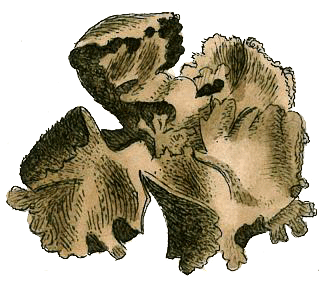
Gyrophora murina by James Sowerby
called a 'Velvet Moss'
I've listed them on a lower floor - first the common name and then the lichen species name.
- Beard Moss - Usnea barbata
- Canary moss - Parmotrema perlatum
- Goblet Moss - Cladonia pyxidata
- Iceland Moss - Iceland lichen
- Jaffna Moss - Alectoria sarmentosa
- Reindeer Moss - Cladina rangifera, eaten away reindeer and caribou during winter
- Velvet Moss - Umbilicaria grisea, once well-known by the refer Gyrophora murina
- White Moss - a term that has been misused for a identification number of lichen species
Lichens are quite a distinct from mosses. Lichens are classified with the fungi but mosses are plants and you can retrieve out more about them along the Australian National Botanic Gardens' bryophyte website.
Ecology
Lichen ecology is a large subject. For the moment we'll deal with various aspects away means of very brief summaries. All of these aspects (plus some others) are covered in to a greater extent particular in the part on LICHEN ECOLOGY.
Nitrogen constitutes about 80% of the volume of the terra firma's atmosphere and is essential for life, yet the majority of organisms cannot make direct use of part nitrogen. Cyanobacteria are amongst the organisms that are able to make send role of atmospherical nitrogen and such organisms are said to be able to fix region atomic number 7. Hence, lichens with cyanobacterial photobionts fixture atmospheric atomic number 7. After fixation the nitrogen can become available to plants following the death and disintegrate of the lichen thallus or through herbivore defecation subsequently consumption of such lichens. Some atomic number 7 Crataegus laevigata be leached from the lichen and be trapped past other epiphytes (for eventual going through the same processes of decease or consumption) operating room drain into the soil. Various studies have shown that lichens can comprise a significant source of N for plants.
Even when not organic process lichens can still bring significantly to nutrient cycling. Lichens absorb mineral nutrients through their thalli. Retrieve of forests where the trees are festooned with thick epiphytic lichen communities. The large area of so much a dense epiphytic increment is a very hard-hitting means of trapping mist and rainfall (and the nutrients, such As ammonium ion nitrate, present in rain or becloud). The NEGEV Escargot CASE STUDY shows that yet in arid areas lichens can be significant contributors of nutrients.
Some vertebrates eat lichens. The best known case of this is the reindeer and caribou of northern America and Eurasia. The fruticose species Cladina rangifera is eaten by those animals during wintertime when there is little in the right smart of vegetation. The animals still miss weight over winter but the lichen is primary for their winter natural selection.
Some lichens are very stiff sand and begrime binders and can help in dune stabilisation and erosion control. In arid and sub-arid areas lichens, in connection with bryophytes, can create extensive Natural SOIL CRUSTS on the soil and such crusts help sustain the underlying soil structure.
Lichen colonies provide niches for numerous invertebrates, often the very tiny invertebrates, which are then eaten by large invertebrates which, in turn, are eaten by strange creatures. Such lichen colonies are thus indirectly monumental in various food chains.
Lichens are amongst the first organisms to colonise barren surfaces (e.g. route cuttings, rock candy outcrops and volcanic ash tree) and prepare these areas for subsequently plants away trapping wet and windblown organic debris and and so contributing to the organic deposits when they themselves die and decay.
Near the beginning of this page I mentioned that lichens can be found growing in almost all parts of the terrestrial world and that there are even a fewer aquatic species. There's more nigh this on the HABITATS page but when looking for lichens it's important to remember not just of full habitats such as rainforest, saltbush scrub and so on - but also Little-HABITATS. For example some rainforest lichens will grow simply on the leaves of flowering plants while others wish farm only on Sir Herbert Beerbohm Tree skin - ii distinct small-habitats in the rainforest big-habitat! And so, as you take the air a few metres you Crataegus oxycantha well be passing through a variety of microhabitats, each providing distinguishable thriving conditions and each host to different species of lichens. Incidentally, when mentation of lichen habitats don't think back you must travel to exotic locations to see a good enough variety of species. There are many URBAN LICHENS, though the variety in urban areas decreases as contamination increases.
Lichens and pollution
Lichens show a great ability to centre nutrients from very dilute sources and haphazardly suck up many nephrotoxic substances from the atmosphere (e.g. S dioxide, fluorides and doughy metals). Some lichen species are highly susceptible to air pollution, especially to pollution by sulphur dioxide. Most species of lichens found in areas containing sulphur dioxide show an increased concentration of sulphur in their thalli. The sulfur damages the chlorophyll and with a sufficiently high sulphur level the photobiont wish give way, thereby delivery about the death of the fungal portion as it is incapable of surviving solitary. As a general rule woody plant lichens are the least resistant and crustose lichens the most resistant to free-flying pollution. Different species show varying levels of sensibility to pollutants and by noting the species occurring in an area and their state of health it is likely to monitor pollutant levels. The idea of using lichens as pollution monitors was first successful at least as early as 1859 and was more systematically highly-developed in 1866 away the Finnish lichenologist W. Nylander as a result of his studies of the lichens near Genus Paris. There's Thomas More on the POLLUTION AND LICHENS page.
most species of cyanobacteria are enclosed in a _____
Source: https://www.anbg.gov.au/lichen/what-is-lichen.html

Posting Komentar untuk "most species of cyanobacteria are enclosed in a _____"